Your hair does not have to look exactly like a chart.
Many people have more than one pattern on their head. Your crown may be wavier than your ends. Your hairline may have a tighter curl. Chemical treatments, heat, coloring, humidity, age, and damage can also change how your pattern looks.
The goal is not to find a perfect label. The goal is to understand how your hair behaves.
For a broader look at patterns, textures, and the features that make hair different, start with the Hair Types & Textures cluster.
Quick Reference: Natural Hair Types
| Hair type | General pattern | Common traits | Main care focus |
|---|---|---|---|
| 1B | Straight | Straight with body and movement | Volume and oil control |
| 1C | Straight | Coarser, fuller straight strands | Frizz, weight, heat protection |
| 2A | Wavy | Loose S-shaped waves | Lightweight moisture |
| 2B | Wavy | More defined S waves | Frizz and definition |
| 2C | Wavy | Strong waves near curls | Moisture and hold |
| 3B | Curly | Defined ringlets | Moisture and curl definition |
| 3C | Curly | Tight curls and spirals | Hydration and gentle detangling |
| 4A | Coily | Defined O-shaped coils | Moisture and low manipulation |
| 4B | Coily | Z-shaped bends | Hydration and breakage control |
| 4C | Coily | Very tight, less-defined pattern | Moisture, protection, and gentle handling |
For an expanded overview of terminology and texture categories, the Hair Types & Textures Guide is a useful next step.
What Are Natural Hair Types?
Natural hair types are a way of describing the pattern your hair forms without heat, chemical straightening, or styling manipulation.
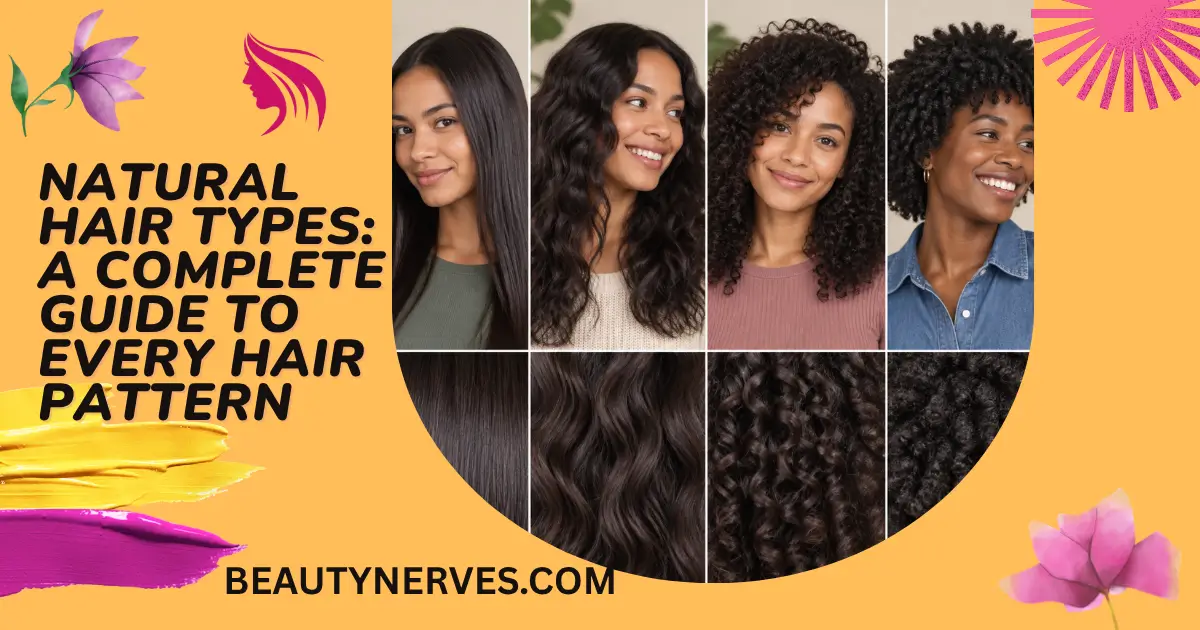
The popular 1A to 4C system divides hair into four broad groups:
- Type 1: Straight hair
- Type 2: Wavy hair
- Type 3: Curly hair
- Type 4: Coily hair
The letters A, B, and C describe differences within each group. In general, A represents a looser pattern, B represents a more defined or moderate pattern, and C represents a tighter pattern.
The system is commonly associated with stylist André Walker and became popular as a simple way to discuss hair patterns. A recent clinical review points out that the system is useful as a consumer shorthand but does not capture every important hair characteristic, such as density, porosity, strand diameter, or the fact that one person can have several patterns.
That is why hair typing should be treated as a starting point rather than a strict scientific diagnosis.
If you are still unsure where your hair fits, compare the pattern after washing and drying without brushing it straight. Your natural pattern is usually easier to see when the hair has not been stretched or heavily styled.
For everyday maintenance, it also helps to look beyond curl pattern and learn the basics in this Hair Care Guide.
Key Takeaways
- Natural hair types range from straight to wavy, curly, and coily.
- The 1A to 4C system is a simple classification tool, not a complete scientific description of hair.
- Your hair can have multiple patterns at the same time.
- Hair type is different from hair density, strand thickness, and porosity.
- Products should be chosen based on how your hair behaves, not just its type.
- Curly and coily hair often need more careful moisture and detangling routines.
- Tight hairstyles can cause breakage and, when repeated, traction alopecia.
- You do not need to force your hair into one category to care for it properly.
Understanding the Four Main Natural Hair Types
Before looking at individual patterns, it helps to understand the four main families.
Type 1: Straight Hair
Type 1 hair generally falls straight from the roots without a strong natural wave or curl. Because the strand does not bend as much, natural scalp oils can travel down the hair more easily.
This can make straight hair look shiny, but it can also make roots look oily faster.
Type 1 is divided into 1A, 1B, and 1C. The differences are mainly related to the amount of body, texture, and coarseness.
People with straight hair often benefit from avoiding heavy products near the roots. Too much oil, butter, or rich styling cream can make the hair look flat.
If your hair is straight but feels fuller and more textured than very fine straight hair, 1B Hair may be the closest description.
Type 2: Wavy Hair
Type 2 hair forms a visible wave rather than a complete spiral. The wave can range from barely noticeable bends to strong S-shaped patterns.
Wavy hair can be tricky because it may look straight when wet and become much more defined as it dries. Brushing it after drying can also break up the wave and create frizz.
Type 2 includes 2A, 2B, and 2C.
People with 2A Hair often have loose waves that need little styling. Lightweight products usually work better than heavy creams.
Type 3: Curly Hair
Type 3 hair forms visible curls, loops, or spirals. The curls may be loose and large or tight and compact.
Curly hair often needs more attention to moisture because the bends in the strand can make it harder for scalp oils to travel from the roots to the ends.
This does not mean every curly head needs the same routine.
For example, 3B Hair generally has tighter, more noticeable curls than 3A hair, while 3C hair forms even tighter spirals.
Type 4: Coily Hair
Type 4 hair has very tight coils, bends, or kinks. The pattern can be clearly defined or difficult to see without close inspection.
Coily hair can experience significant shrinkage. A strand may look much shorter in its natural state than when stretched.
Type 4 hair also benefits from gentle handling. The American Academy of Dermatology notes that curly and tightly curled hair is more prone to dryness and breakage, which makes careful washing, conditioning, detangling, and styling especially useful.
You can explore the differences between 4A Hair, 4B Hair, and 4C Hair when you are ready to identify your specific pattern.
1B Hair: Straight With Body
1B hair is straight but usually has more body than very fine 1A hair. It may have some natural movement and can hold certain hairstyles better than finer straight hair.
The strands can look smooth and shiny, especially when healthy.
A common mistake with 1B hair is using too much product. Because straight hair does not have many bends, heavy creams and oils can quickly weigh it down.
Best care approach for 1B hair
- Use a lightweight shampoo and conditioner.
- Apply conditioner mainly from the mid-lengths to the ends if your roots become oily.
- Use lightweight styling products.
- Avoid excessive dry shampoo buildup.
- Protect the hair from frequent high heat.
- Brush gently rather than aggressively.
If you have 1B hair and want more volume, focus on the roots rather than coating the entire length with heavy styling products.
Your 1B Hair resource can provide a more focused look at this pattern.
1C Hair: Straight and Coarser
1C hair is generally straight but tends to have more thickness or coarseness than 1B hair. It may have a slight bend, especially toward the ends.
This hair type can look dense and full. It may also be more resistant to curling and can become frizzy when exposed to humidity or damage.
A useful routine starts with balanced cleansing and conditioning.
Avoid assuming that coarse hair automatically needs very heavy products. Strand thickness and dryness are separate issues.
Someone can have coarse hair that becomes oily quickly. Another person can have coarse hair that feels dry.
For a closer look, see 1C Hair and compare its characteristics with 1B hair.
2A Hair: Loose Waves
2A hair has a gentle wave pattern. The hair may appear almost straight at the roots before developing loose S-shaped movement farther down the strand.
This pattern can be easy to style but may lose definition under heavy products.
Tips for 2A hair
Use lightweight conditioners and styling products. Apply products mainly to the lengths and ends. Avoid brushing the hair repeatedly after it dries because this can separate the wave pattern and increase frizz.
A small amount of mousse or lightweight styling cream may help create definition without making the hair greasy.
People with 2A Hair often find that less product produces better results.
Your goal should be to support the natural wave rather than force a stronger curl.
2B Hair: Defined S Waves
2B hair has a more noticeable S-shaped wave than 2A hair. The pattern may start closer to the roots and become stronger toward the ends.
Frizz is a common concern, particularly in humid weather.
The biggest styling mistake is often over-brushing. When the hair is dry, brushing can separate the wave clumps and make the hair look fluffy.
Instead, detangle gently when appropriate and allow the wave to dry with minimal disturbance.
For more detail on this pattern, explore 2B Hair.
A simple 2B routine
- Cleanse the scalp gently.
- Condition the lengths.
- Detangle carefully.
- Apply a lightweight leave-in if needed.
- Add mousse or another light styling product.
- Scrunch the hair.
- Let it air-dry or use gentle heat.
- Avoid repeatedly touching it while it dries.
2C Hair: Strong Wavy Hair
2C hair sits near the boundary between strong waves and loose curls. The pattern is usually easy to see and can have substantial volume.
Some sections may look almost curly while others remain wavy. That variation is normal.
Because 2C hair can be more prone to dryness and frizz than 2A hair, it may benefit from more conditioning. At the same time, very heavy products can flatten the wave.
If you have 2C hair, experiment with product weight instead of assuming you need the richest formula available.
See 2C Hair for a closer breakdown.
3B Hair: Defined Ringlets
3B hair typically forms tighter, well-defined curls than 3A hair. The curls can have a springy appearance and may form ringlets throughout the head.
Moisture and curl definition are usually major priorities.
The American Academy of Dermatology recommends conditioning curly hair thoroughly and using gentle detangling techniques. Dermatologists also advise avoiding unnecessary dry brushing because it can increase breakage and frizz.
For many people, 3B Hair responds well to styling in sections.
Caring for 3B curls
- Wash when the scalp needs cleansing.
- Condition thoroughly.
- Detangle in sections.
- Use a leave-in conditioner if your hair benefits from one.
- Apply curl-defining products to wet or damp hair.
- Avoid rough towel drying.
- Limit unnecessary heat.
- Protect curls while sleeping.
If your curls are frequently tangled, divide the hair into manageable sections rather than trying to comb through the entire head at once.
3C Hair: Tight Curls and Spirals
3C hair generally has tighter curls than 3B. The curls may form compact spirals and can have considerable volume.
The main challenge is often keeping the hair hydrated without making it feel coated or heavy.
Your routine should also account for shrinkage and tangling.
Do not judge the health of 3C hair simply by how much it shrinks. Shrinkage is a natural result of the curl pattern.
When detangling, work from the ends upward and avoid rushing through knots.
The 3C Hair cluster can help you focus on this tighter curl pattern.
Product selection for 3C hair
Look for products based on your actual needs:
- Dry hair may need richer conditioning.
- Fine strands may need lighter formulas.
- High product buildup may call for occasional clarifying.
- Frizz may improve with better styling technique rather than more product.
- Difficult detangling may improve with more slip from your conditioner.
There is no universal “best product” for every 3C head.
4A Hair: Defined Coils
4A hair usually forms clearly visible, tight O-shaped coils. The coils can be springy and compact.
The tighter bends make moisture distribution and gentle handling especially important.
Natural oils do not move down a tightly coiled strand as easily as they can along straighter hair. This is one reason coily hair can feel dry even when the scalp produces oil normally.
A good routine focuses on retaining moisture and reducing unnecessary manipulation.
Explore 4A Hair if your hair forms consistent, defined coils.
4A hair care checklist
- Keep the scalp clean.
- Condition regularly.
- Detangle gently.
- Work in sections.
- Avoid excessive heat.
- Use protective styles without excessive tension.
- Sleep in a way that reduces friction.
- Trim damaged ends when needed.
The goal is not to make 4A hair behave like straight hair. The goal is to keep the natural coil flexible, conditioned, and protected.
4B Hair: Z-Shaped Coils and Bends
4B hair tends to form sharper bends rather than consistently round coils. The pattern can resemble a Z or compressed zigzag.
The hair may look fluffy or less defined, especially without styling products. That does not mean it is unhealthy.
Definition is a styling result. Hair health is a different question.
For 4B hair, moisture retention and gentle handling often matter more than trying to create perfectly separated curls.
The 4B Hair guide is useful if you want to compare this pattern with 4A and 4C.
Common 4B mistakes
One common mistake is excessive manipulation. Constant combing, brushing, stretching, and restyling can increase breakage.
Another mistake is relying only on oils for moisture. Oil can help reduce friction or seal in moisture, but it does not replace water or conditioning.
Start with hydration and conditioning. Then use oils or creams according to how your hair responds.
4C Hair: Very Tight Coils
4C hair is generally characterized by very tight coils or bends. The pattern can be difficult to see without stretching or close inspection.
Shrinkage can be significant, and the hair may appear much shorter than its actual length.
4C hair is not automatically “dry,” “weak,” or “unhealthy.” Those are separate characteristics.
Two people with 4C hair can have completely different strand thicknesses, densities, porosities, and moisture needs.
The 4C Hair cluster is helpful when you want to focus specifically on this pattern.
How to care for 4C hair
Start with gentle handling.
Wash the scalp and hair regularly enough to maintain scalp health. Condition the hair thoroughly. Detangle when the hair has enough moisture and slip to reduce pulling.
Protective styles can reduce daily manipulation, but they should not be painfully tight.
The American Academy of Dermatology warns that repeated tension from tight braids, ponytails, cornrows, extensions, and similar styles can contribute to traction alopecia.
If a hairstyle causes scalp pain, excessive pulling, or tenderness, that is a warning sign to change the style.
Natural Hair Type vs Hair Texture
Hair type and hair texture are not exactly the same thing.
Hair type usually refers to the visible pattern, such as straight, wavy, curly, or coily.
Hair texture often describes whether individual strands are fine, medium, or coarse.
Density describes how much hair you have in a given area.
Porosity describes how your hair interacts with water and moisture.
These traits can overlap but should not be treated as interchangeable.
For example, you might have 3C curls with fine strands and high density. Another person might have 3C curls with coarse strands and lower density.
That difference can completely change which products work best.
This is why a good Hair Types & Textures Guide should be used alongside your curl-pattern classification.
Natural Hair Type vs Hair Porosity
Porosity is another factor that often gets mixed up with hair type.
Your curl pattern tells you what shape your hair forms. Porosity describes how readily your hair takes in and holds water.
You can have low, medium, or high porosity hair while having almost any curl pattern.
For example:
- 2B hair can have low porosity.
- 3C hair can have high porosity.
- 4A hair can have medium porosity.
- 4C hair can have low or high porosity.
There is no rule saying a particular curl pattern must have a specific porosity.
If you are trying to build a routine, consider pattern, strand thickness, density, porosity, scalp condition, and chemical history together.
For readers exploring that topic, the cluster on Best Oils for Low Porosity Hair provides another useful angle.
How to Find Your Natural Hair Type
You do not need an elaborate test.
Try this simple process.
Step 1: Start with clean hair
Wash your hair normally and remove heavy styling products.
Product buildup can temporarily change how your pattern looks.
Step 2: Condition normally
Use your usual conditioner. Avoid adding a large amount of styling product before identifying your pattern.
Step 3: Let your hair form naturally
Allow your hair to air-dry or dry gently without pulling it straight.
Avoid brushing the hair after it begins to form its natural pattern.
Step 4: Look at several sections
Do not identify your hair from one strand.
Check the crown, sides, back, front, and ends.
You may see several patterns.
Step 5: Compare the overall pattern
If most of your hair forms loose S waves, you may fall within Type 2.
If it forms visible spirals, Type 3 may be a better fit.
If it forms tight coils or bends, Type 4 may be more appropriate.
Step 6: Check your other hair characteristics
Now consider:
- Strand thickness
- Density
- Porosity
- Shrinkage
- Dryness
- Scalp condition
- Chemical processing
- Heat damage
- Color treatment
This gives you a much more useful profile than a single number and letter.
Can You Have More Than One Natural Hair Type?
Yes. Having multiple hair patterns is normal.
The systematic review of hair classification systems specifically notes that common typing systems can overlook the fact that people may have multiple hair types on the same head.
For example, someone might have:
- 2C waves near the front
- 3A curls underneath
- 3B curls at the crown
Another person might have 4A coils around the sides and 4B or 4C areas elsewhere.
Do not feel pressured to choose one label.
If different sections behave differently, create your routine around those differences.
How Hair Type Affects Your Hair Care Routine
Your hair pattern can influence how much moisture, styling control, and detangling support you need.
Straight hair
Straight hair often needs lightweight products because oils can travel down the strands easily.
Wavy hair
Wavy hair usually benefits from lightweight moisture and products that enhance definition without weighing the pattern down.
Curly hair
Curly hair often needs more conditioning and careful detangling. Curls can become dry and tangled when handled roughly.
Coily hair
Coily hair often benefits from moisture retention, sectioning, low-manipulation styling, and careful detangling.
But these are starting points.
Your personal routine should be adjusted according to how your hair responds.
How to Wash Natural Hair Without Excessive Damage
The American Academy of Dermatology recommends focusing shampoo on the scalp rather than aggressively rubbing the length of the hair. It also recommends conditioning to help reduce breakage and split ends.
A simple washing routine looks like this:
- Wet the hair thoroughly.
- Apply shampoo mainly to the scalp.
- Massage gently with your fingertips.
- Let the shampoo rinse through the lengths.
- Apply conditioner.
- Detangle gently when appropriate.
- Rinse thoroughly.
- Apply leave-in or styling products if needed.
- Dry with minimal friction.
How often you wash depends on your scalp, lifestyle, product use, and hair needs.
There is no universal wash-day schedule for every Natural Hair Type.
How to Detangle Different Natural Hair Types
Detangling should reduce knots without creating unnecessary tension.
Straight and loosely wavy hair can often be detangled with a suitable brush or comb, while curly and coily hair may be easier to manage when wet or damp with conditioner providing slip.
For tightly textured hair, the AAD recommends thoroughly wetting the hair, applying leave-in conditioner, and using fingers, a wide-toothed comb, or a brush designed for curly or coily hair.
A useful technique is to divide the hair into sections.
Start at the ends.
Remove small knots.
Then slowly work toward the roots.
Never force a comb through a large knot simply because you are in a hurry.
Heat Styling and Natural Hair Types
Heat can affect every hair pattern.
Flat irons, curling irons, hot combs, and frequent high-temperature blow drying can weaken hair over time.
The American Academy of Dermatology recommends limiting excessive heat and using the lowest effective heat setting when blow drying.
This matters because damaged hair can become more fragile, brittle, frizzy, and prone to breakage.
If you use heat:
- Start with clean, properly prepared hair.
- Use an appropriate heat protectant.
- Avoid repeatedly passing a hot tool over the same section.
- Use a lower effective temperature.
- Give your hair breaks between heat-styling sessions.
Your Natural Hair Type does not make you immune to heat damage.
Natural Hair Types and Protective Styles
Protective styling can reduce daily manipulation, but the style itself should not create excessive tension.
Loose braids, twists, buns, and other low-manipulation styles may help reduce handling.
However, tighter is not better.
If your scalp hurts during or after installation, the style may be putting too much stress on the hair or scalp.
Repeated tension can contribute to traction alopecia, and the AAD recommends reducing tight hairstyles that continuously pull on the scalp.
Protective-style checklist
Before wearing a protective style, ask:
- Does the style hurt?
- Can I move my scalp comfortably?
- Are the edges under heavy tension?
- Is the style excessively tight?
- Will I be able to clean my scalp?
- Am I giving my hair breaks between installations?
A protective style should protect your hair, not create a new source of damage.
Common Natural Hair Type Mistakes
Mistake 1: Treating hair type as a strict identity
You do not have to be only one type.
Hair can vary across your head.
Mistake 2: Choosing products by curl type alone
A 3C label does not tell you whether your strands are fine or coarse, whether your hair is low or high porosity, or how dense your hair is.
Mistake 3: Using too much product
More product does not always mean more moisture.
Too much styling cream, oil, gel, or butter can create buildup and make hair feel coated.
Mistake 4: Brushing dry curls aggressively
This can disturb curl formation and increase frizz and breakage.
Mistake 5: Confusing shrinkage with hair loss
Coily hair can shrink dramatically. A shorter appearance does not necessarily mean the hair has stopped growing.
Mistake 6: Wearing painful hairstyles
Pain is not a sign that a style is working.
Repeated tension can damage the hair and scalp.
Mistake 7: Copying someone else’s routine
A person with the same curl pattern can have completely different density, porosity, strand thickness, lifestyle, and chemical history.
Use other people’s routines as ideas, not rules.
Pros and Cons of Hair Typing
| Pros | Cons |
|---|---|
| Gives people simple language for describing patterns | Does not describe every hair characteristic |
| Helps beginners understand basic differences | Can encourage overly rigid labeling |
| Makes product and styling discussions easier | Does not predict exactly which products will work |
| Provides a starting point for routines | One person can have multiple patterns |
| Helps organize hair-care information | Does not measure hair health |
The best approach is to use hair typing as a communication tool.
Do not let a label decide what your hair is “supposed” to do.
Expert Tips for Building a Natural Hair Routine
1. Start with your scalp
Healthy-looking hair starts with a healthy scalp environment.
If you have persistent itching, scaling, pain, sudden shedding, or unexplained hair loss, consider speaking with a dermatologist rather than trying to solve a medical problem with styling products.
2. Learn what your hair actually needs
Instead of asking, “What does 4C hair need?” ask:
“What does my 4C hair need right now?”
Dryness, buildup, tangling, breakage, and lack of definition can require different solutions.
3. Change one thing at a time
If you introduce five products simultaneously, you will not know which product helped or caused a problem.
Change one major part of your routine at a time.
4. Keep notes
Write down:
- Shampoo used
- Conditioner used
- Styling products
- Wash frequency
- How long your style lasted
- How your hair felt afterward
- Amount of tangling
- Amount of breakage
After a few weeks, patterns become easier to spot.
5. Focus on consistency
A simple routine that you can maintain is usually more useful than a complicated routine with ten steps.
A Simple Natural Hair Care Routine
If you are starting from scratch, use this basic framework.
Wash day
Cleanse: Keep the scalp clean without aggressively scrubbing the lengths.
Condition: Apply conditioner thoroughly and give it enough time to soften the hair.
Detangle: Work in sections and remove knots gently.
Style: Use products based on your hair’s needs.
Dry: Minimize friction and excessive heat.
Between wash days
- Avoid unnecessary brushing.
- Refresh curls or waves gently.
- Protect hair during sleep.
- Watch for buildup.
- Avoid repeatedly pulling on the same areas.
Monthly review
Ask yourself:
- Is my hair breaking?
- Is it too dry?
- Is my scalp comfortable?
- Am I using too much product?
- Is my styling causing tension?
- Does my current routine still work?
Your routine should evolve as your hair changes.
Natural Hair Types and Product Selection
Hair type can help narrow your choices, but it should never be the only filter.
For example, a person with 2A hair may prefer a lightweight mousse, while someone with 4B hair may prefer a richer conditioner.
But even within those categories, preferences can vary widely.
A product that works beautifully for one person may leave another person’s hair greasy, stiff, dry, or coated.
When evaluating a product, consider:
Pattern: Straight, wavy, curly, or coily.
Strand thickness: Fine, medium, or coarse.
Density: How much hair you have.
Porosity: How your hair handles water and products.
Current condition: Healthy, dry, damaged, colored, chemically treated, or heat-styled.
Goal: Definition, softness, volume, moisture, hold, length retention, or easier detangling.
This approach is more useful than buying products simply because the label says they are designed for your hair type.
When Natural Hair Types Change
Your natural pattern can look different over time.
Possible influences include:
- Heat damage
- Chemical straightening
- Coloring
- Bleaching
- Hormonal changes
- Aging
- Hair length
- Product buildup
- Moisture levels
- Damage and breakage
- Styling habits
For example, hair that once formed tight curls may appear looser after repeated heat styling.
That does not necessarily mean your underlying biology has permanently changed. It may reflect damage or altered fiber condition.
Likewise, cutting off damaged ends can make a curl pattern appear more defined.
Natural Hair Types: The Bigger Picture
The most useful way to think about hair typing is as a map.
Type 1 helps describe straight hair.
Type 2 describes waves.
Type 3 describes curls.
Type 4 describes coils.
The letters help describe differences within each family.
But the map is not the territory.
Hair is more complicated than a number and letter.
A complete hair profile might look like this:
“I have mostly 3B curls with some 3C sections, medium-density hair, fine-to-medium strands, and hair that tends to become dry at the ends.”
That description tells you far more than simply saying “I have 3B hair.”
It also gives you a better starting point for choosing products and building a routine.
Frequently Asked Questions
What are the four main Natural Hair Types?
The four main groups are Type 1 straight hair, Type 2 wavy hair, Type 3 curly hair, and Type 4 coily hair. Each group is further divided into subtypes in the commonly used typing system.
Is 4C hair the most fragile hair type?
Not necessarily. Hair fragility depends on many factors, including strand structure, damage, handling, chemical processing, heat, and styling tension. Curl pattern alone does not determine hair health.
Can I have two Natural Hair Types?
Yes. Many people have different patterns across the same head. Your front, crown, sides, and back may behave differently, so using two or more labels can be reasonable.
Should I choose hair products based only on my Natural Hair Type?
No. Curl pattern is only one factor. Also consider strand thickness, density, porosity, scalp condition, dryness, damage, and your styling goals before choosing products.
Why does my Natural Hair Type look different after washing?
Water, conditioning, styling products, shrinkage, drying method, and product buildup can all affect how your pattern appears. Heat and chemical processing can also alter the visible pattern.
When should I stop using a hairstyle?
Stop or change a hairstyle if it causes pain, significant scalp tension, repeated breakage, or irritation. The American Academy of Dermatology warns that repeated tight hairstyles can contribute to traction alopecia.
Final Verdict: Natural Hair Types Made Simple
Natural Hair Types are useful because they give you a simple way to describe your hair pattern. But they should not become a set of rules.
Your hair may be 1B, 2C, 3B, 4A, 4B, 4C, or a mixture of several patterns. That is normal.
The most useful routine comes from looking at the whole picture: curl pattern, strand thickness, density, porosity, scalp condition, damage, lifestyle, and styling habits.
Use the 1A to 4C system as a starting point. Then pay attention to what your own hair tells you.
Healthy hair care is less about finding the “perfect” type and more about using gentle, consistent habits that suit the hair you actually have.
References
Hair.com — Natural Hair Types Chart: What Type Am I?
https://www.hair.com/hair-texture-chart.html
Hair.com — Our Ultimate Guide to Finding and Caring for Your Curl Type
https://www.hair.com/curl-types.html
Hair.com — What Is My Hair Type? Here’s How to Find Out Once and For All
https://www.hair.com/hair-type.html